Sunday, July 24, 2011

Jala a Las FLores

Our biggest project at present is the work being done in Las Flores to provide water for the village. I first visited the spring and village leaders in the spring 2009. After we struck and agreement for the village to provide all manual labor gravel and sand, we then sought and received funding from Rotary International and the Olson Foundation. Finally in February 2011 we sign papers with the mayor of Chajul to share in around 50% of the material cost. The very next day we purchase cement and rebar to start work on a holding tank above the village and the work began.
This community has around 900 inhabitants and is located just across the river from Chel. The community grew out of villagers from Chel locating across the river in a patch of Jasmine flowers but after a time they saw the need to incorporate to seek help with schools, water and other community needs. Actually the full name of the village is Jala a La Las Flores. It is a sing song sound – Jala a Las Flores which is a mixture of Spanish and Ixil that simply means “The other side at those flowers”. As I review my photos and remember my time there I feel that if the village name were a song it would be a mixture of hardship and hope. Poverty and the past have written a long story of struggle. One photo that was taken of me alone at the end of a day work, a day in which I was so exhausted I was virtually useless struck me. I was there. I shared that song, the struggle and the hope and I so am thankful to be a part of it.

Here we are in front of the home and store of the Mayor or alcalde of Las Flores. He obviously was not elected due to having a rich and elaborate lifestyle.

We met inside his home, which sleeps five, to discuss the first day’s work. After two years of planning and a week after we delivered materials we were finally ready to start work on the large holding tank half an hour walk above the village.

Ah, at last the first day of work on the site of the holding tank.
Digging and packing seem to always be the first step of a water project!

Our ordered wheelbarrows did not show up until the third day so we do what we always do in Guatemala- improvise. The man in the white shirt is Manuel Lopez the village “cocodes” a nonpaid representative of the regional government. He has given so much time to make this project happen it is incredible.

Progress comes little by little

Every house hold has to participate even the mayor. I don’t know if that concept would catch on with our leaders here in the states but it has merit.

I found the alcalde to be quite a character. Here he is digging for treasure in a small cave we uncovered. This hope was not unfounded because as we dug down around three feet we continuously would find small pieces of pottery.

here is a part of our collection.

I was excited to find the nicest piece of obsidian. It is very common that wherever you dig in this region you find pottery pieces testifying to the long existence of the Ixil people here.

A representative of the ministry of health (man in the vest) stopped by during lunch the third day of our digging. He was performing a purity test on our spring and very impressed with the chlorine filter that we will install at this tank. It will be only the 4th village in the 60 of Chajul to have a filtered system. The two other men in the photo are the Alcalde and Manuel Lopez, village cordinator

Well, the hole is dug and a rebar grid laid out in preparation for the concrete floor.

Our next need was for sand, cement and rock to be carried to the site. Every household was responsible to carry an equal part. A few had mules but most of the men had to carry the loads on their backs.


The climb to the site took me ½ hour with a light load. It goes up and
up and up

1,500 100# sacks would be carried to the site before we finished the tank.

I am amazed at the determination of these people to better their community.

We also needed water so with 100 20’ pieces of PVC we set up a temporary water source. I forgot a handsaw that day but an Ixil can do almost anything with a machete

Success!

On mixing day it took me three trips up the hill to get everything ready. Around 10:00 we were ready but I wondered if it was too late in the day to begin but everyone wanted to go ahead so the mixing began. I appreciate the lessons of days like that when I become frustrated becuase life is not going according to my organized plan and I just let it go. Many time lo and behold a good day comes inspite of myself.

We would build three of four mountains of concrete mixture, dry mix them

then add water and stir.
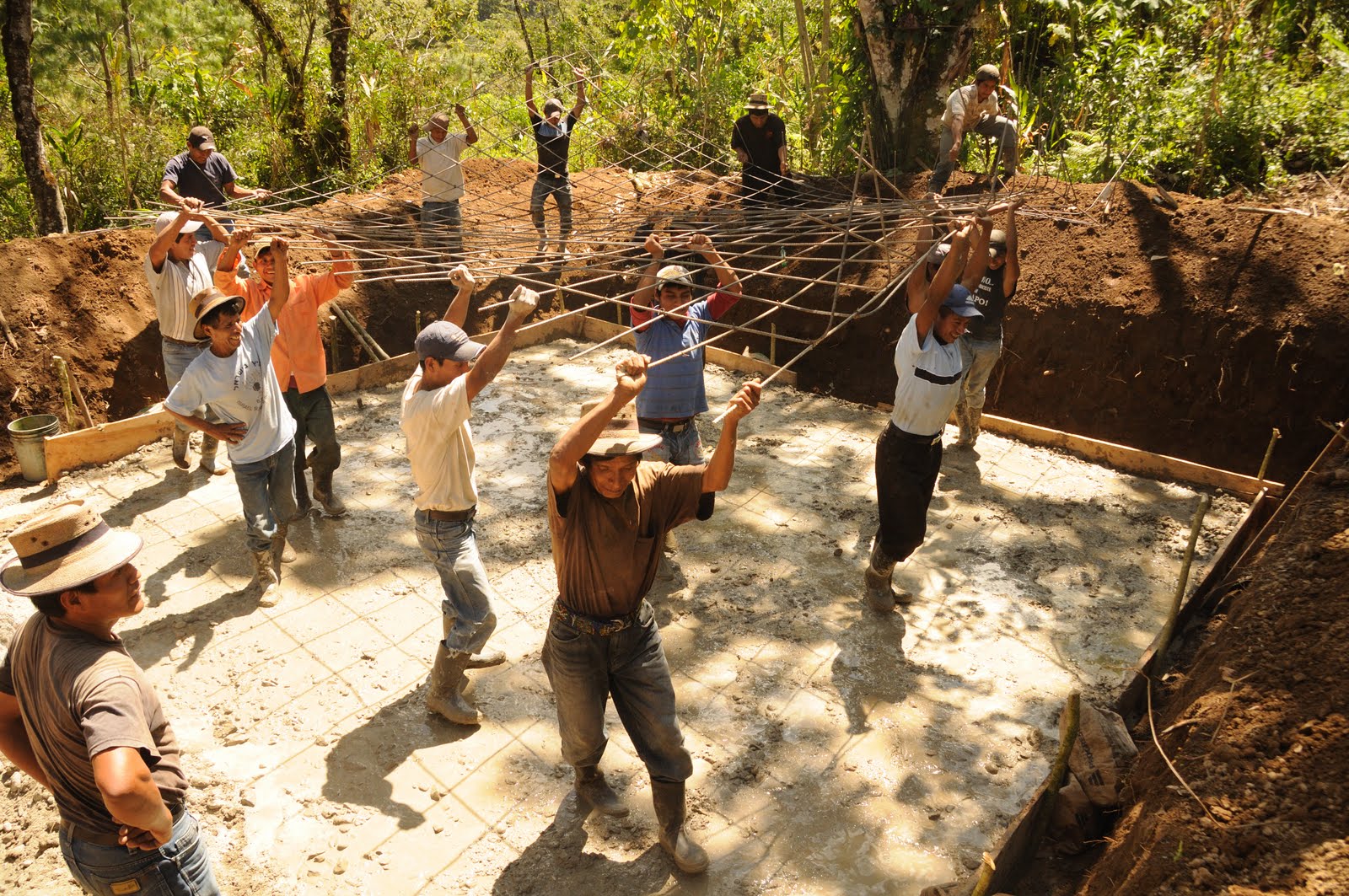
Placing the rebar grid.

this is a quarter of the way through the day.

By days end I was exhausted. Here we are mixing te last pile


The day after the pour we started forming the walls. Two sectors of villagers were assigned to transport lumber that was cut from a donated tree further up the mountain. This lumber was rough cut with a chainsaw on a hillside grade of 45 degrees.


In total we moved 336 boards three boards at a time.

It was a nice break from the backbreaking work of hauling, digging and mixing to start forming the walls of the tank. This tank is quite large measuring 20’ x 23’ and 7’tall.


The alcalde or mayor is helping nail boards here. He is the shortest man I know from the village and probably around 4’6”. I don’t know how much he weights but he can still pack 100# sacks of cement and sand around pretty well.

Even though I spent two months in the region with all of my different responsibilities I only had two weeks to actually work with the village on the tank. A few days after this photo I turned the work over to one of the masons in the village and started my journey back home. I was tired and looking forward to showers and a more varied diet but very grateful for the progress we had seen with in these projects.
It has been three and a half months since my visit and a lot has been accomplished since then. The holding tank is finished and the municipal has delivered all the piping they promised. The first part of July we purchase more cement and rebar to start work on a collection tank at the spring. The village is mobilized working digging ditches and laying pipe. In October I will return and it is anticipated we will install the water filter and have a completed water system for almost 1,000 people. I personally feel very thankful. Thankful to the village for the willingness to work so hard for a better future, to the people at The Rotary and Olson foundations for having such caring hearts and enough faith to provide the seed money to make this project possible. I also am grateful to the municipality of Chajul who step up to the plate and served their people. Lastly and always I am thankful to our donors who help us cover the loose ends to see this project to the end. When I am back again in Jala a Las Flores and turn on a facet in front of a house and know every family has clean safe drinking water at their doorstep I will be thinking of all the help along the way and offer a pray of blessing to each of you. Thank-you all Michael

Saturday, April 23, 2011

January visit 2011

What were you doing when you were six? Playing jacks?

When you were ten, were you weaving your own clothes?

Was there medical care for you as a child? We meet this girl while buying pigs in Illom. After her mother sold me a pig I looked in her house and noticed this girl. She has laid on the floor with little appetite for twenty days and her mother was selling the pig so they could afford medicine. We purchased the medicine for her as well as the piglet. Many of these people live life making choices I am thankful I have not had to make.


But with the help we’ve been able to provide, they have a better chance earning a living like those in our pig program.

January 22nd my wife, Carol, and I boarded an AA jet and began her first trip to visit the Chajul region in Guatemala. By reporting some of our experiences, we hope to share a clearer picture of the work The Ripple Effect is doing in the lives of our Guatemalan friends.


We spent our first week of the trip at a Spanish language school on the shores of Lake Atitlan in the small town of San Pedro la Laguna. It was a good transition week for us, living with a middle class family, having access to the resources of a town and honing our Spanish. While there, we visited Panajechel and some representatives of Miracles in Action, an organization we’re starting to work with more closely.

The folks at Miracles in Action pitched in with a gift of 6 gunny sacks of supplies to take back up into the villages. It was exciting to inventory the trove of gifts, knowing they meet the critical needs of the wonderful people we would be seeing in the upcoming weeks. We had blankets, backpacks, hygiene kits, shoes and knitted hats. Those gifts swelled our pieces of luggage to 13 - a lucky number. If a traveler has 2 or 3 pieces he will try to carry them himself, but when there are 13 it’s clear he will need help. To make the ripple effect happen, I have to remind myself to count on others for help.
This was my first visit to the lake. Carol visited this area in 1980 and was amazed at the changes in the villages. Then there was only a handful of gringos and the men dressed in traditional clothing. Now whole blocks of the town were set-up to cater to foreign travelers
We stayed with Pedro and his wife Deborah. He is both a teacher and an excellent painter. Because of his personal history both of these achievements are amazing. His father was alcoholic and at age 13 Pedro left home, ending up on the coast to work in the sugar cane fields. There he cut sugar cane in the blazing heat for 50 cents a day. He often slept in the streets and began to drink to stay warm. He quit drinking and managed to get certified as a teacher. He told us in 2012 he will not have to work full time and has volunteered to go to the Chajul region to help teach the children painting and horticulture two weeks a month. His motive—help others in poverty the way he was helped.
Well how did we move our luggage? We started by boat across the Lake, and then hired a shuttle bus to take us to a highway junction. The shuttle was for tourists on their way to Antigua, and it made me laugh to see their reaction when we were dropped off alongside the highway to wait with our mountain of gear for a public bus. In about 5 minutes, a bus came, the helpers loaded us up and we were off to our next transfer in Santa Cruz Quiche.
Santa Cruz is the “department capital of Quiche,” the department that Chajul is part of. Our transfer there was in a terminal and for a couple of dollars, two men with carts hauled our supplies to the proper "bus" and we sat down at a street vendor’s booth for breakfast before leaving in a micro-van. We started the day at 6am and would arrive in Nebaj to spend the night and purchase some more supplies at around 3:30.


The next morning in Nebaj Andres, one of my friends from Chel arrived with a local driver to transport us to the village. With some help from friends in Nebaj we finished buying enough stuff to reach a load of 2500#, which is considered a full pick-up load. Adding six more bodies on the truck, we started the final 3.5 hour trip to Chel. Direct travel time from the states to Chel takes two and a half days.

The ride on into the village is a slow crawl through the mountains, but even this road was not here 15 years ago. Back then, to walk in you needed to start at 3am and would arrive in Chel around 8pm. I have heard elders say the people have it easy these days. I guess it is all a matter of perspective. There is a tiny top of a mountain peeking out of the cloud in the left hand side. That is where the town of Chajul is. Chel is in the valley below and Nueve Puntos is one hour travel more behind where this photo was taken.

It feels like an accomplishment and a big homecoming whenever I summit the last ridge and see Chel and Las Flores in the valley below. These communities of 3,000 and 1,000 respectively are the center of our work. It was where we first started working with a cattle project mirrored after The Heifer Foundation model. This visit we are helping 120 women develop ways to support their families and we’re starting a water project in Las Flores.
Homes are simple, made of poles or boards with cracks that the wind blows through. Floors are normally uneven dirt with an open fire. We will be staying with the family of the president of the women’s collective. 80% of all animals run free which contributes to polluting the water supply.

These two communities are clustered along both sides the Chel River. The river is a real blessing to everyone, but there needs to be cultural education to protect it. Pollution from both the lack of a sanitation system and trash are visible everywhere. Present day marvels such as plastic and Styrofoam have arrived, but the education on how to dispose of them lags behind. After using an item, the wrapping or bottle is thrown to the ground without a second thought. When trash is collected it is burned in the streets.
Coffee is the best cash crop in the area. After picking the cherries, they must be de-husked and washed. Then the beans are laid out in the sun to dry. Each night the beans are collected and stored to be protected from condensation or a surprise rain storm. After five days of drying the beans are bagged and trucked to market
Weaving is the prided tradition of the women. Young girls will learn to weave by the age of 8. In fact by the age of 8 or 9 the girls are able to cook, clean, wash clothes and care for younger siblings.

Many of my poorer friends only have two sets of clothes. One to wear and while the other one is being washed. This woman has a deluxe “laundry room” in comparison to women with just a board in the mud to bend over and wash on.

The starting point of helping people is getting to know them. Juana Bop the collective’s president and diferent committee members took Carol and me to various homes of the women in our programs. Each morning for three days we visited these families, and in the afternoon, Carol helped in the clinic, assessing needs and dispensing medicines. Pictured here is Rosa Pecheco who has participated in our pig program. She has raised and sold her first animal and purchased a replacement animal with the proceeds of the sale. Now she is starting to grow 500 coffee plants we offered. She told us durning the war she fled to the mountains with her baby and lived there for five years with only some plastic for a house.
Maria and Manuela are sisters. Their father’s hand was shot off in the war. In total there are 13 people in this 15x20 house. They eat twice a day, each meal consist of beans, some leafy greens and tortillas. The plastic on the walls is to keep the wind and night cold from blowing in. Each bed has only one blanket and sleeps at least two people. They are raising two sheep provided by TRE and will entered our vegetable gardening program during this visit


Each afternoon for three days the Local clinic was opened for the women. Carol with a local assitant provided ceck-ups and free medicine.

Maria
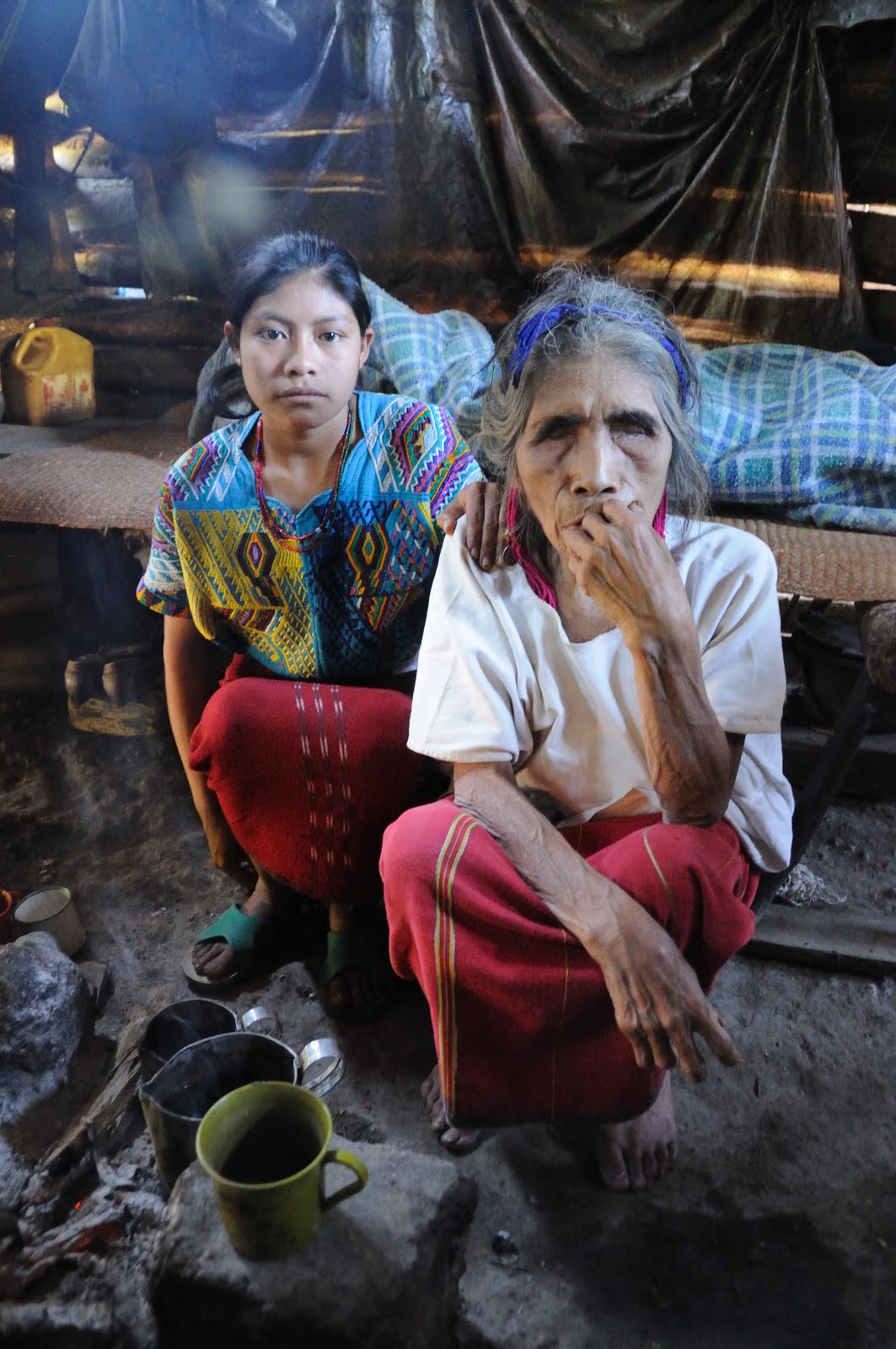
Maria is almost 80 years old and sits here with her granddaughter, Katarine. Maria lost sight in one eye when she was young. During the war when the village was burned, she was led by one of her grandchildren into the mountains to hide. A few years later, her second eye closed, leaving her blind. She can’t work and has trouble walking. She’s in a monthly food program and on this visit we bought her padding for her bed to ease her aches and pains.

Juana and Rosa
Carol offered medical help during the home visits. Juana had problems breathing and had very little strength.
Rosa might have been suffering from tuberculoses


Anna’s husband died a year and a half ago. She has 5 children to care for. None are attending school. Anna has been sick for 15 days with diarrhea, a bad cough and general aches and pains. We gave her cough syrup, vitamins, food and three new blankets


Magdalena and grandson
Magdalena told us about fleeing the burning of the village with five children. For four years she hid from the military. Crossing a fast moving river with the children she then traveled to the plantation La Perla to seek asylum. She has raised and bred a pig donated by TRE

The woman below is also named Magdalena and she told us that she has bred the sheep she received and is waiting for the lamb. We are wanting to buy a ram for these women to use.


Hacinta
Hacinta proudly showed us her new lamb and the sheep we gave her in May 2010. They use the word semilla to describe animals they will breed. It literally means seed and represents their hope to grow a small heard. One young man was reported to have cried for three days when his sheep died, because with it his hope to create a small business died also. The gifts you help provide are small but extremely important.


What did we do with all our luggage? One afternoon we carried it to one of the local churches
The seven women on the committee and Andres, Juana’s husband, are indispensable to the management of our work.
The Church pictured below is pastured by Martin a mason we used to build the water tank in Xesally. e fought for six years with the rebels and has quite a story. You can read more about him in the blog entry "Personal Side of War"


We called all the women in our programs together to discuss the upcoming work and gave out clothing, blankets, and backpacks. During this visit we would be distributing more pigs, starting coffee nurseries and a vegetable garden program.

You might have notice that Carol was dressed in Ixil clothing. A Huipil, or blouse, takes almost two months to weave. Yet she was given five huipiles from different women.

This are one of the school
backpacks provided by Miracles in Action.


Between here and Nueve Puntos, we gave away around 800 clothing items, 40 backpacks and 50 blankets.


Toward the end of our first week, we bought and distributed pigs to part of the 65 women that we chose for that program. After buying pigs in the morning, the women arrived and formed a line.
We used our chicken coop for a corral, and the first order of entertainment was catching the pigs.

If for your birthday or Christmas you ever receive a pig, there are a few different ways you can bring it home.

wrapp'em or rope'em


or just put them in a bag

As we ended our first week in Chel, we send a heatfelt thank-you for the help,gifts and donations that have made this work possible.