Saturday, January 25, 2014

Esperanza Chel and Horno Chel


The time had arrived to head back up the mountain and visits our project villages in the route to Caba. We, the Ixil committee of TRE decided to include two new villages in this route. Of the seven villages we would visit four are newly established communities. I think an explanation of why these new villages are forming and the importance of this movement is needed. Poverty in the Ixil region as well as in all of Guatemala is directly tied to land rights which were taken away from the indigenous people at the time of the Spanish conquest. Over the years land titles have changed hand but have never reverted back to the native population. In the 1940’s there was a ray of hope as a platform to redistribute unused land was put forth by the government. Unfortunately it was squashed and thirty-five years of civil conflict and oppression followed. Finally in 96 a peace accord was signed which included the ability for native populations to reclaim land that was not being used and held in large plots usually by non-local owners. The communities of Esperanza Chel and Horno Chel are a great example of  these communities. After years of waiting the goverment has starting opening homestead communities that allow landless farmers to have a ray of hope.


Why do we go into the mountains to visit these communities? The answer is easy, because of the great need. It is that simple. When it is possible to help meet basic needs of water, food, and clothing with such little investment of finances and with such strong community support to work together how could we not go. In this blog we visit two of the communities Horno Chel and Esperanza Chel. The majority of the habitants have relocated from the Chel area. They have never owned even an acre of land yet are subsistence farmers who would pay rent of up to half of the harvest from a crop to the landowner on whose land the farmed. Now for the first time in their lives they have legal access to up to 35 acres of land. Can you imagine what new opportunity that means for their families and future.  Esperaza Chel-  it is aptly named “The Hope of Chel” These communities have no potable water, no school, no electricity, no road yet they have hope for the future. It is with great joy TRE enters into a commitment to help these communities and offer you our sponsors the opportunity to help share in their hope. The opening photo is of a girl at the hand dug collection well for the community of Horno Chel, 22 families share this well. The spring that feeds this well is clean and only a five minute walk from the village but they don’t have a collection tank to protect it. It would only cost $2,500 to build a collection system with a hand pump. I know there is someone who could just write a check or gather five friends to contribute $500 each and give this village the materials needed to protect their water. It seems so simple.


                     Well let’s get on with the journey and see these villages.
  The day we left was raining and cold and quickly brought back memories. Our coffer Manuel was REALLY amazing as we worked our way up the mountain. I need to video this trip sometime because my words could not give it justice. After two and a half hours we reached the summit and were meet by men from both villages who had been waiting to receive us. I did not ask how long they had been waiting but we were over two hours late in leaving Chel. It is a great feeling to be so well received. The piping and four of our gunny sacks will continue with the truck to Los Encuentros but we gathered up seeds and general aid to carry into the villages.


  The trail to the village made me feel right at home as this is normal life here. Mud and rain. What is amazing is how much celebration and laughter accompanied us.


 Here we are entering the village Horno Chel. Almost all the homes have a roof made of Pox leaves. It takes almost 100 plants to harvest enough leaves for a five meter by seven meter home.

Warming up by the fire. Roofs with out walls are used for public meetings and shelter during a workday.


             A new sweater and toy animal provided by Miracles in Action.
 I know the picture looks sad but there is a cultural preference not to smile for a photo. When women laught many cover their mouths. I think it is out of embarrassment over their teeth which often are in sad states of decay.The other day I handed out toothbrushes, which are a rare comodity here, and one of the girls brushed her teeth for over half an hour. She was so excited to have her own toothbrush and the feeling of clean teeth.


 Here are some of the community members. This is defiantly a working camp as the men try to prepare the community to better house their families. The village was founded in April 2013 and is so raw you can see clear through most of the houses. We had a good meeting after which we distributed seeds and hats, ponchos and sweaters. With night approaching we quickly headed down the trail to Esperaza Chel


  The night broke clear and cold in Esperanza. In the morning I watched the setting of the full moon while waiting for the first rays of the sun to warm us.


  As always I have an escort where ever I go. The cildren thought it was halarious when I called them Patush- ducks, for following me around in a file. A stranger would cause a stir in these villages but a gringo is defiantly good entertainment.


  This boy sits by his family’s water collection system. It is easy to see how scarce water can become. It is common to pass a container of dirt water around before a meal so everyone can wash their hands.
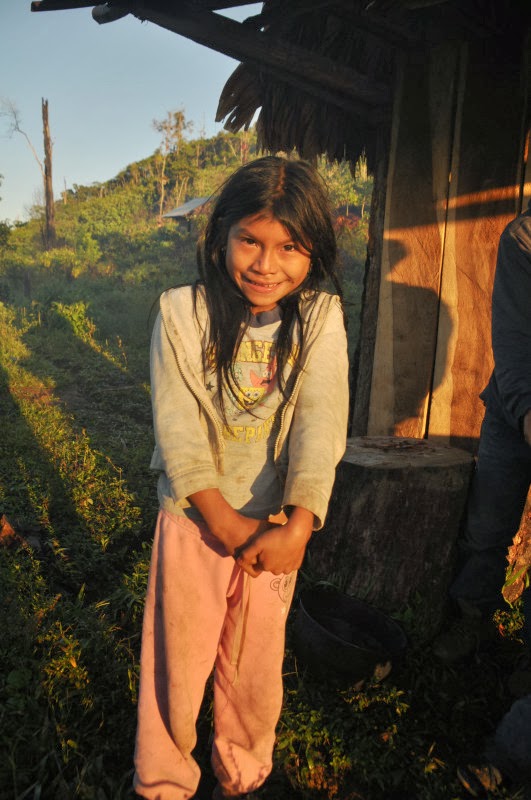


                                                A nice morning smile


The fathers who started this village came here in November 2012.Why would a father bring his family into a situation like this? No water, no school, new fields to clear and plant, no houses.


Here are the men who have done this as we meet and listen to their needs and explain how and when we can help.


  For me and for them it is clear why they have come here. I think this picture shows their hope pretty well. Imagine for the first time in your life  you as a farmer  have land to plant.  You don’t have to pay ½ your wages in rent, you don’t have to walk an hour or more to the field, and there is room for your children to have their own land and homes. This is Esperanza Chel, the hope of the village of Chel. The brown field in front of his house is full of new corn plants!


  Their farming practices are good. Here they are leaving a ground cover that protects from the sun and rain while decomposing for a future crop. We will come back with bean seeds so they can plant bush beans alongside the corn which will fix nitrigen into the soil.


This man is keeping the fields clean enough that the crop planted benefits from all the resources on the site using a machete and hooked stick called a gancha.


  Time to celebrate and share some aid. Here we are carring out five gunny sacks of aid.


While Andres organized the general aid I got our seed factory going with some local help. We bagged and labeled seeds for the community.


                                                                        Forming the aid line

Andres is reaching into the sack to see what surprise will be next. All the hats in the picture were knitted in the states.
                                                   Hats and stuffed animals for every child.

These little gifts that seem small to us are not small gift here.  Ninety percent of these children have never had a stuffed animal so this is a day to remember

 A gift of a sweater or coat is really appreciated.  Two days latter we entered another village in which almost all the clothes were rags.


                    A photo of thankfulness and amazement at his good fortune


Bagging and labeling seeds. We have divided the village into two groups with a center leader responsible for each group. On our next trip we will bring in seed storage containers for a seed bank, more seeds and the material to build green house. In March we will start hosting open house sessions at our nursery in Xesally and leaders from all the villages will come to learn and share ideas.


Although there is a lot of potential in a hat full of seed our garden program has much deeper roots as we are training and working with the people to reach the long range goal of seed self sufficiency and sustainable agricultural practices
                                                                Happy Children
                                                    The founding fathers of Esperanza Chel

Back to work. Before we had left the village the men were back clearing field and the women working around the home. Here one is using the washing machine.


A rain water collection tank made of wood and plastic. There are micro organism that degrades the plastic in six months so this tank needs constant maintenance and is open to any containment. The adobe structure beside the tank is a steam bath house.

So here is the village as we left it. It is dependant on rain water for drinking but has great land potenial.


Some of the men lead us to the village spring on the way out. The trail in front of us is cleared and planted on both sides for the next twenty minutes of walking.


The spring lies in the bottom of a funnel. This land feature is common but does not allow for the development of gravity fed water systems. The spring in this case does not have enough flow in the dry season anyway. We are studying a rain water collection system that we put in at another village. After the dry season we can evaluate what the cost would be per house to place concrete holding tanks with a water filter system at each home. We put Esperance Chel on the list of communities that would benefit from this type of system.


On the other hand the spring at Horno Chel flows under this little bridge to a hand dug holding tank. This spring gives a good constant flow, is close to the village and would only need proper protection to function well for the community.


It is one of those simple needs that from the perspective and resources of the village will have to wait a long time. From my perspective, knowing the resource we have in the states I wonder why. Join us and make a difference!

Sunday, January 12, 2014

A Nursery en Xesalli


For the last two weeks I have been thinking hard about my next step in our Personal Garden Program. The decision felt important and heavy. Much of my life I have stopped and waited before a major decission out of fear of making the wrong decission. The decision of where to put  and how to arrange a nursery and personal home while I work here will definitely affect my future and that of the  program for the next year or two. The decision was difficult in part because I was about to place myself right in the middle of a poverty stricken community. Not as a visitor but as a member with the vision to train how to garden in a new climate with different diseases and insects. How will this affect me I am not sure, the rich man in the centre of poverty.

  While I was thinking about the possibilities of this decision I found good council form a excerpt from the book “40 Chances- Finding Hope in a Hungry World” The book statement was “Don’t be afraid to take Risk” and “Learn from your mistakes.” I had my decision. If God guides us it isn’t always by strong words but by whispers and dreams. Perfection is in the hands of God, action is in mine. I am marching forward.

  And it was a joyful start! The following photos are the begining of a dream to establish a nursery from which we can learn, train and collect seeds. The vision is much bigger than this small site I am borrowing and starting to cultivate. It is a vision to use this whole community as a nursery. This green house is our third here and using the space between the homes and garden sites we are able to grow pure seed from many different varieties. Right know we are eating beans and corn but why not yams, fruits and berries, green vegetables, what ever can be grown here?
  The upcoming week we are heading into the mountains to visit five communities. We are helping them with drinking water projects and vegetable gardens. How basic can you get. Join with us. All donation go directly into these projects. YOU can make a difference
 

Un Vivero en Xesalli 
Hace dos semanas pienso duro en el próximo paso de nuestro programa de Hortalizas. La decisión fue importante y se pasa hacerlo.  La mayoría de my vida yo paraba y esperaba hacer un decisión por el miedo hacerlo mal. La decisión a donde y como poner el vivero y un hogar se afecta mi futuro y el programa. La decisión me cuesta porque yo sé que voy a meterme en un comunidad pobre. No como un visitante pero como un miembro. Con un visión ensenar cultivar verduras en un clima diferente con plagas desconocido. Que me afectara’- el rico quien entro adentro los necesitados.  
    Mientras contemplo los posibilidades encontré buen consejo del libro “40 Chances- Finding hope in a hungry world” El consejo decía “no tenga miedo hacer riesgos”  y “Aprenda de sus equivoques” Ya viene el claro! Si Dios nos guía no es siempre por palabras fuertes pero por palabras susurradas y sueños intimitos. La perfección esta en las manos de Dios y la acción en mío. Adelante me voy.  
  Y con qué feliz avancemos! Los siguiente fotos son del empieza de una visión establecer un lugar a practicar métodos de cultivar hortalizas y crecer semillas. La visión es más de mi sitio que esta prestado. La es para la comunidad entero, por la región.  Usando los sitios de mis compañeros hacer espacios suficientes  guardar variedades de semillas diferentes y puro en forma de tiempo sembraríamos los montañas alrededor nosotros. Ya comemos frejoles y maíz. ¿Por qué no camote, fruta, hojas verdes, zanahorias y todas las verduras posibles a crecer?
  La semana que viene iré a visitar cinco comunidades más lejanos adonde tenemos proyectos de agua potable y hortalizas. Se interesan la gente la oportunidad enfronte, a beber y comer mejor. ¡Tan básico son las necesidades! Nos acercaban y trabajamos junto. Todos sus donaciones ir directamente a las programas. Puede hacer una diferencia.


This was my green house team for the third greenhouse. It is such a simple design that the kids cut the pieces and put it together.

 
But you will soon see that these kids love to work and help.

 
During a break they serenaded me with pipe pieces. They were actually pretty good.

 
Streaching the tarp

 
turned into a tug of war!

 
Victory over the tarp

 
They learned so fast. They are used to watching the adults work and will copy them so exactly. I guess all kid do that which places a great responbility on the whole community to set a good example.

 
Heading home after a short day.

 
This is the site of Antonio. We have three varrieties of yams in the front beds. In total we have 50 yam plants from four varieties which should yield 150 plants in three months!

Here is Felipe who is in charge of the groups in three villages.

 
We purchase 700 fruit bearing trees and 200 strawberry plants. These will be handed out over the next two months.

 
Back to my green house. I had the men do the hard work of turning the soil. I can not do this alone which makes me dependant on a good principle--work together!

 
The kids are loading top soil into sacks and a wheel barrow to put in the greenhouse.

 
This size of bag is not light. They always tied it with an old string that gave my fingers fits to undo. They did not want to spill or waste anything.

 
Two pulling and one sterring. They learned this by watching their dads work.

 
Every age helped. My camera was fogged up much of this morning as I would watch these kids place one rock in a gunney sack and carry it to me.

 
Building the bed walls. The fathers took note knowing the rocks would not rot. I preach never, never walk in a bed and this makes the designation easy for everyone to see.

 
Bringing me rock

 
Each kid wanted me to personal receive and notice their efforts. 

 
Almost done. Monday we will finish. We have planted 1/2 of this and wil propable have 500 transplants in three or four weeks.

 
The men continue their work. We shaved of the grass and placed it in mounds to decompose. Latter we will turn the soil and form our beds. I hope after that not to have to turn the soil again. We will add organic matter as a mulch to contiue provide good planting surfaces.

 
Well, yes my body aches but I love this work. Gardening, hiking, and helping, not a bad way to live.

Thursday, August 1, 2013

POTABLE WATER IN CABA AND LAGUNA CABA


FAMILIES SERVED 85 PROJECT COST $9390


Meet Phillipe and his son. Let see what has happened in their village.
Last November I was guided on a trip to visit to the villages of Caba and Laguna Caba. The trip’s purpose was to take a look at the water needs in these villages.  These villages are sister villages and share virtually the same site. In all there are 85 families in this locality. This place has a special history because during the 80’s it was a refuge center for the people fleeing from the surrounding villages. I was often told that every spot on the hillside was full of people during that time.

REBUILDING THE SPRING BOX
    When I was shown the village spring and water system that they were using I was immediately drawn into the idea of helping develop and purify the water supply.  Here was a village of 85 families, over half of whom did not have water to their home. The present water system did not have a holding tank and was left exposed to parasites and bacteria. Much of the existing piping had even become clogged by a type of worm. Yet on the positive side the spring was excellent yielding over 30 gallons a minute. It was also closer to the village than any other site I had yet visited so the cost would be lower and finally the leadership was willing to work hard in service for their village.

Martin  the alcalde in 2012 and his family with Nicolas another village leader.
           Let me explain my impression of the leadership. The second time we visited the Caba I visited Nueve Puntos on my way in. We had enough blankets and vegetable seed for every family in Caba and Laguna Caba but we needed porters to carry the aid from Nueve Puntos to Caba. The Porters that were supposed to arrive from Caba to help us did not show up so we hiked to the village and left the aid in Nueve Puntos.  This trail is rough and we were in the middle of the muddy season.It is a secondary trail that snakes through some pretty broken territory. Arriving late in the evening we were exhausted. We explained to the alcalde (the village leader) that we needed the aid in the village by the end of the next day. This meeting took place at 9:00 at night yet he gathered 4 volunteers and one mule for the journey. They all got up at 3 am to make the two way trip to Nueve Puntos to bring back the aid.


Imagine going up or down these in the dark.
 Around 5 pm I got worried because they still had not arrived back so I hiked up to the top of the first pass. My feet were so sore from the previous day’s journey I knew it was not smart for me to go any further. I waited and waited for them to arrive. As twilight began to descend I keep inching my way back to the village. With each small retreat I prolonged the daylight as I was exiting the thicker forest. Finally before I made the last descent and the light totally faded they arrived in the trail. As we descended together we were meet with whistles and calls that were sent up the hill from others who had been waiting. The hikers sent back their answers signaling all was well. Instead of frustration at such a taxing journey there was pride and joy at the mission accomplished. They had hiked from 3 in the morning to after 7 at night to bring this aid to their people. I know the comparison I mentally made was not totally equal but I wondered how many town mayors in the states would make a journey like this to help their community. This was not only an extremely hard physical trip. One that I personally could not have done but it was risky. The trail was intense proven by the fact that the mule that left with them that morning had fallen. It was ok but they left it back up the trail with a family to heal up for a few days.  Making this trip was a sign of extreme dedication that would make building a new water system possible. That night I personally made a commitment to the alcalde to come back in March to begin the water project. We would find the money somehow.

a look at the water flow from the spring
   Meanwhile back in the states without any knowledge of these events two families decided to make a strong contribution to TRE. The amount was equal to the need and in a space of three weeks we had the finances and a plan. It felt almost divinely orchestrated that the time for clean water had arrived for Caba.
            So after that long introduction let’s take a look at the ripple that was created.


                                                              MARCH 2013


 THE SIGNING


  When I arrived back in the village almost 500 bags of sand and gravel had already been carried into the village. El family was responsible to carry river sand and gravel back from the river below. It was a steep one hour climb . This was a little scary for me to see work begun before we had made all of our final agreemnts. The purpose of this visit was to establish the plans for the system, do a final material list and cost analysis, and sign a final agreement. The village was so eager that they had already begun gathering materials.


TRE Office in Caba, Laguna Caba
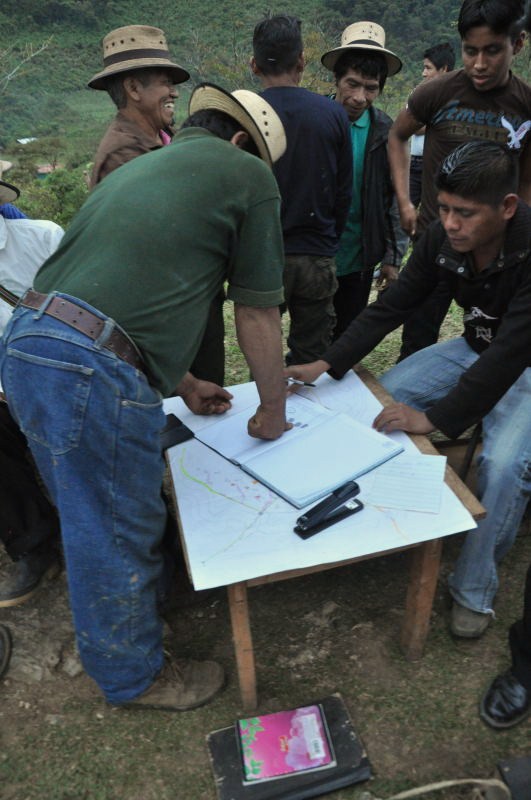
    I personally don’t like a lot of office work but my office in Caba was pretty sweet. We needed to make a map of the village and layout the system. This lets everyone see a “picture” representation of the project. It also is the easiest way for me to start a material list, final cost analyses and a written agreement with the village. I can not remember when I was happier to be working at a desk


But with a penthouse view like this who wouldn’t enjoy it. The valley that is in the right side of the photo drops off so steep it is a 45 minute journey down to the river below. That is where the sand and gravel were gathered.

After a couple of days we had finished the map and other paper work and it was time to call a village meeting. Remeber Phillipe he is behind the bull horn. This is the small ridge between the two communities and it serves as a great town hall.

Here Andres is describing the project and who will be responsible for each part of the project. We had divided the project into three parts like we normally do and the responsibility for unskilled labor again fell upon the villagers. In this case a added struggle was that the closest road we could truck materials in on was still 5 hours away. There would be around 300 trips needed just to bring the materials to the site.

Martin the alcalde in 2012 is nominating another community member to be part of the water committee. They needed 4 members. It was funny to watch this process. Different men who have been dedicating time in community service throughout the past year would nominate another friend who they felt would be good for the job. They had done their service and now it was someones elses time. The problem was that the job meant extra unpaid work that no one really wanted. Some men who knew their name was coming up would kind of hide behind someone else and then kick the ground when they were nominated. Everyone would laugh and give a personal sigh of relief it was not them. I understand and respect these nominees. Their lives are hard and more work is not what they need. Service is not free.


The Signing


There are two common highlights in a water project. One is when the finances and agreements are  finally finished and in place and we are ready to work. The second is when the taps are opened for the first time. Both feel like moments of great accomplishments. When the agreement was verbally finalized the men gave TRE a round of applause for coming and offering help. I too was clapping and some men laughed becuase the applause was for me. They thought I had not understood  but I told them no I am applauding in joy that we, all of us, have arrived in this place of aggreement. What a good day!