Many of you know that 2014 was my first full year living in Guatemala. One of the main opportunities that this has presented me is the development and expansion of our garden program. In a country that rates third in the world for malnutrition this goal has immediate importance. Please join me for a tour of our work and the changes we have seen. (Photo of Gaspar's garden in Sotzil)

Let's begin with a walk to my garden in Xesalli. Years earlier the village had build me a small room to call my own alongside one of the homes. It seemed like a good place to look for a temporary spot to garden and build a home/office. It is a short 20 minute walk up the hill from Chel and offers a little privacy and beauty. The road has a couple of rough spots in it so it is cheaper to bring most things in by mule. Here Mateo leads their family's mule to my site with a load of blankets and mandarins oranges for the village. We have made countless trips up and down this road carrying everything from chickens to fruit trees.
Home sweet home! (This photo was taken in November 2014)
It is good to take a little look back to see what has been accomplished. We began work on the site in January. These kids have come to the end of a work day helping me build a simple hoop green house. The blue tarp behind them is the spot we would build a small adobe house for me.
Fast forward to November and we can see the changes in this site.
Here back in January again some of the men of the community help expose the soil for the first planting. I was excited to see nice black soil but when we tested it there was no measurable nitrogen and almost no phosphorus. ( Take note of the position of the man in the green shirt. A few weeks after this photo we piped a water faucet in front of his location.)
Today the site looks like this. You can see the water faucet in front of the women who have come for an instructional class and are ready to head back to their villages. Each one of them have a few plants starts to take home and work with. Besides all the growth we have seen on the site we have been able to gift thousands of plant starts.
Here below the house we have almost 2,000 peach tree starts growing. This is our root stock that we will later invite garden leaders to come and learn how to graft different varieties onto. In 2014 we have handed out over 2,000 fruit trees. They have ranged from tomato trees to oranges to apples. Placing these trees and training in the hands of the village farmers is going to help us establish a new level of food security. Remember this is just our first year. I dream of seeing the surrounding 20 villages being a bread basket. This is not a vision to export food to foreign markets but so that they can feed themselves.
I plan to always stay a grass root type of guy. That is who I am. Here I am enjoying carrying a few plant starts to a meeting in a neighboring village. It is a low tech kind of work that cost almost nothing but yields good return.
The plant starts delivered here will be divided between 30 gardeners. Pictured here are hibiscus starts, chaya plants and yucca trees.
In 2015 TRE is looking to purchase a five acre parcel of land where we can expand this type of garden nursery. Included in this plan is a training center from which to teach village technology, herbal medicines, animal and plant husbandry.
The adobe blocks for my house arrived in mid- June. They were transported up the hill by pick-up. I chose adobe because out of the material choices available it had the lowest impact on the environment and provided local people with much needed work.
Hiring three of my nieghbors I was surprised to find out none of them had ever built with adobe. Life seems to be full of lessons and we used this opportunity to learn together. It was a fun four days.
After years of construction in the US I enjoy a more relaxed approach to building. I enjoy the freedom to put higher value on relationship building than the building itself. The fact that it only cost me seven dollars a day for labor and the entire house project was under a thousand dollars has helped me maintain that perspective.
Here two neighbors entering the garden gate bringing me poles for the roof. To bring the ploes down the mountain they have dragged them for half and hour.
Let's leave my garden behind and go visit some of the villager sites. This site belongs to Elena and is producing well.
Here she showed me a trick I have never tried. She has placed an upside down black pot here to show the cabbage plants what size of heads she is wanting. I don't know if there has be any scientific studies done on her method but I do see other gardeners doing the same thing!
Many of our new sites require a ton of soil improvement. This site was so compacted that it was hard to break the soil with a pick. Maria is collecting the small rocks to be discarded. Behind her is a bed with better soil that her husband has carried down from the mountains. Two months later I was amazed to pass by this garden and find a healthy crop of swiss chard growing.
Because of the great demand for garden wire we have started requiring new gardeners to prove their interest by first tending a garden plot with whatever fence materials they can find. This site and 40 others in her village have fulfilled that requirement and are now fenced with wire.
Sites like these are popping up all over.
The beauty of these gardens is seeing the food that is available without cost to these families.
With over 300 gardens the regional representatives of the Ministry of Agriculture have told me that when they tour these villages they are amazed. There are gardens everywhere! We have started sharing information, resources, and tools with the Ministry of Agriculture and Xacbal, the national dam in this area. Last week we planted 100 fast growing trees in the village of Sotzil to help stabilize hillsides that were putting home at risk for landslide. The trees were provided by Xacbal.
In 2015 I hope to photograph more gardens and less swollen belles. Please visit our web site and help us make that change. To donate for a year end tax credit, to see one more garden built, for the children are all good reasons.
We are a 501-c non profit and 100% of your donations go directly to these projects.
Harvest time is near.
A site this size cost $60 to fence and plant.
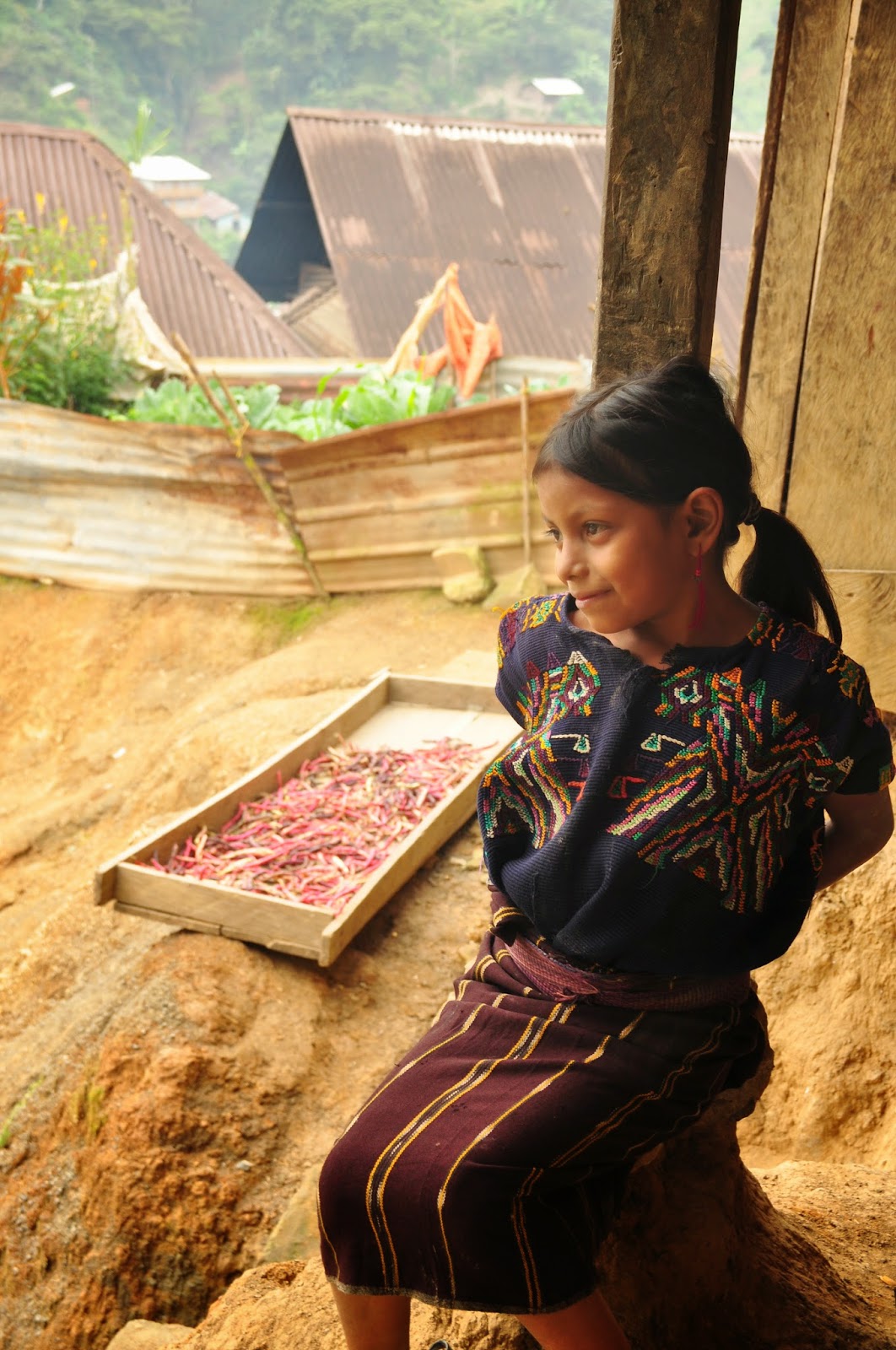
I love this photo. The shy smile on the girl, the beans drying that have been harvested from the fields and the vegetables that are peaking over the metal fencing of the garden. There is potenial here. Potential for tomorrow let's patner together to see that it is achieved. Malnutrition, especially for the young is a lifetime problem. Brain, physical growth, and organ develop are all stunted. Now is the time to protect the future.
Join us in 2015 and let's seed the mountains!

 The other day two mules arrived for the neighboring village of Cajchixla to carry back some laying hens we had been raising.
In two trips using five mules we delivered 175 laying hens in total.
tuli mula toq'in tiq'ozan kaaxhan. Ben O' kaval viaje iq'o 175 tuxh kaxhan
The other day two mules arrived for the neighboring village of Cajchixla to carry back some laying hens we had been raising.
In two trips using five mules we delivered 175 laying hens in total.
tuli mula toq'in tiq'ozan kaaxhan. Ben O' kaval viaje iq'o 175 tuxh kaxhan
 I hired two neighbor ladies to raise day old chicks until they were 5 weeks old. The pay for this work was five quetzales or sixty-six cents for each chick successfully raised.
Kat lok in kaval ixoq kat chizan inq'a tuxh kaxhan
I hired two neighbor ladies to raise day old chicks until they were 5 weeks old. The pay for this work was five quetzales or sixty-six cents for each chick successfully raised.
Kat lok in kaval ixoq kat chizan inq'a tuxh kaxhan
 In order to catch the last chickens in the coop Pedro the father at the home had to send in a specialist, his daughter Maria. We could buy laying hens in Nebaj but by working locally we not only help with a little income but add training. Some of the lessons that are added include "how to make a better chicken coop"- one that is easy to clean, protects the hens well and has good access for eggs and catching birds.
Oc me'al nak u vinaq' lu maj kaxhan
In order to catch the last chickens in the coop Pedro the father at the home had to send in a specialist, his daughter Maria. We could buy laying hens in Nebaj but by working locally we not only help with a little income but add training. Some of the lessons that are added include "how to make a better chicken coop"- one that is easy to clean, protects the hens well and has good access for eggs and catching birds.
Oc me'al nak u vinaq' lu maj kaxhan
 The second woman Maria and a neighbor girl Jacinta are loading her birds for transport.
Kaval Ixoq nuko kaxhan
The second woman Maria and a neighbor girl Jacinta are loading her birds for transport.
Kaval Ixoq nuko kaxhan
 Loaded and ready to go. It is a simple route form Xesally to Cajchixla. Down one hill, up the next, across the ridge and back down.
Mat ja tiq'o kaxhan. B'an b'ey la b'en ex tenam cajchixla. Mat ex copon yane japon. Inpal tz'aq'ala tul yane ben ex copon paq'te
Loaded and ready to go. It is a simple route form Xesally to Cajchixla. Down one hill, up the next, across the ridge and back down.
Mat ja tiq'o kaxhan. B'an b'ey la b'en ex tenam cajchixla. Mat ex copon yane japon. Inpal tz'aq'ala tul yane ben ex copon paq'te
 Arriving in the flats at the ridgeline. Although this is in a dry season the mud stays on the flats. It is an hour and a half trip in all.
Kat ul e' tzaq'ala mamla x'ocol. Kam hora vete cajchixla? Val hora nik.
Arriving in the flats at the ridgeline. Although this is in a dry season the mud stays on the flats. It is an hour and a half trip in all.
Kat ul e' tzaq'ala mamla x'ocol. Kam hora vete cajchixla? Val hora nik.
 ku' ko cupon
 The Arrival V ul
 We filled a pen with the chickens as a crowd of women came to watch. Nosa u xahoraal tuxt kaxhan mientras Inq'a Ixoq gil mamla
kaxhan
We filled a pen with the chickens as a crowd of women came to watch. Nosa u xahoraal tuxt kaxhan mientras Inq'a Ixoq gil mamla
kaxhan
 A few escape always.
 The distributed chickens were placed in gunny sacks for the final leg of their journey. Ak cu xe sarco u kaxhan. mate totzotz u ixoq tuxh kaxhan.
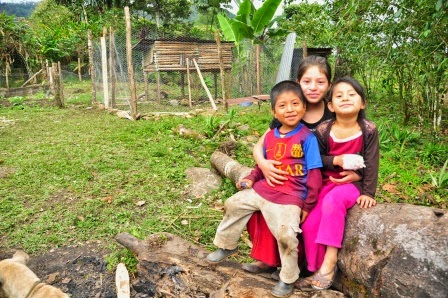 We now have 36 chicken coops and pens. Our final design is more or less like this one behind the kids. It offers good ventalation, access to a run, separation of the manure from the coop and as well as other features. We are beginning a vacination program, studing alternate locally grown feed sources, and working to choose the best breeds.
 So what can you do? Send me some more birds. If you don't have a mule for the trip, ventilated boxes for U.P.S., or an extra suitcase, when you come to visit you can just go to our web page and donate through Pay-pal. Whichever is easiest I will leave that decision up to you. I would like to reach a goal of 150 layers per month and three new coops. The coops cost $140 and the chickens four dollars each.
 The following are just a few more photos from the day. This girl was a little camera shy.